
9 Game Success Factors for Driving Engagement at News Publications

 Norkon Team
 For many publishers, launching a game feels like the finish line.
The platform is live, announcements are sent, and promotions run for a few weeks.
But after an initial surge in registrations, not much happens.
This pattern is quite common. One of the main reasons media games underperform isn’t unfitting technology or the game concept itself, but the fact that games are often treated as standalone products instead of ongoing initiatives.
Drawing on real-world experience from financial publishers running successful Fantasy Funds stock market investment games, this article outlines nine key steps publishers must take to turn their investment game into a sustainable, audience engagement engine.
The 9 success factors at a glance
Phase 1: Strategy & Foundations
1. Don’t treat the game as a product, but as an ongoing event
2. Strong partnerships make media games credible
3. Accessibility expands the audience for media games
Phase 2: Launch & Momentum
4. Launching a game requires editorial-level visibility
5. Influencers accelerate adoption of media games
Phase 3: Engagement Mechanics
6. Social competition, a core engagement mechanism
7. Reward design determines retention
8. Game length directly impacts engagement
Phase 4: Long-term Value
9. Post-game engagement and long-term value
Let’s dive into each aspect!
9 key factors to make your media game a success – based on real-world experience
1. Don’t treat the game as a product, but as an ongoing event
One of the biggest misconceptions about games for publishers is the idea that they are “launch and let it do its magic” experiences.
In reality, successful news and media games are treated like an editorial program. They require planning, regular activation, and continuous communication throughout their lifecycle. Without reminders to return or personalized updates, even highly engaged audiences gradually disengage.
Publishers that treat games as living initiatives rather than one-off features consistently see stronger engagement and longer-lasting impact.
2. Strong partnerships make media games credible
A successful investment or stock market game rarely runs in isolation.
Trusted partners such as banks, exchanges, or data providers add far more than sponsorship revenue. They reinforce credibility, extend marketing reach by leveraging their own channels, and raise the perceived quality of the experience.
For players, strong partnerships signal that the game is legitimate and worth their time.
For publishers, partner selection is critical. Random or poorly aligned partners weaken trust, while the most effective media games are built around partnerships that reinforce brand values and audience relevance.
3. Accessibility expands the audience for media games
The most successful media games feel approachable and inclusive, not intimidating.
Lowering barriers to entry significantly broadens the audience, whether through simple onboarding, inclusive design, or flexible participation. When games feel educational and entertaining rather than complex, they also attract first-time participants, families, and younger audiences.
An accessible game that anyone can join at any time should be a core part of a publisher’s growth strategy to maximize registrations and return on investment.
4. Launching a game requires editorial-level visibility
Games don’t stand out by default, they need a clear moment of importance.
Rather than quietly releasing a game, successful financial news publishers treat the launch as an editorial event. High-profile announcements, influencer involvement, and prominent coverage across platforms help establish momentum from the moment registration opens.
One financial publisher, for example, marked the launch of its Fantasy Funds game with a live “ringing the bell” ceremony at the NASDAQ Baltic headquarters in Tallinn, signalling importance, credibility, and editorial commitment.
If a game launch feels ordinary, audiences will treat it that way.

Äripäev investor game winner at the NASDAQ Tallinn office, 2025. Credit: Liis Treimann
5. Influencers accelerate the adoption of media games
Influencers are a highly effective lever when they are genuinely involved in the game.
When influencers actively participate, appear on leaderboards, or manage visible portfolios, they naturally create stories worth sharing and following. Their audiences follow them not because of promotion, but because of visible, authentic involvement.
This reflects a broader industry shift. Research from INMA highlights the growing overlap between journalists, subject-matter experts, and influencers, particularly in specialised domains such as finance and investing. Games provide a natural, transparent format for this evolution to take place.
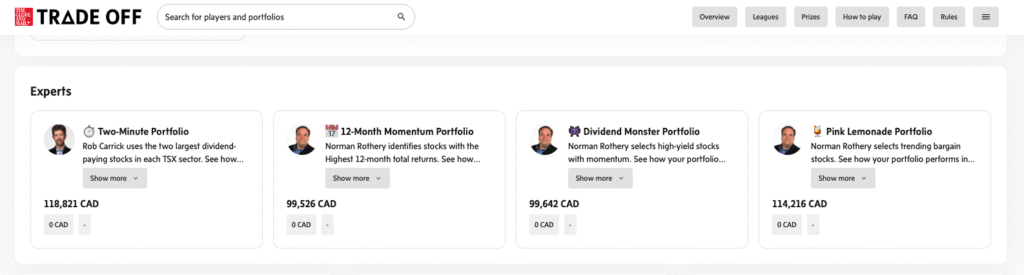
The Globe and Mail’s Trade Off game allows players to follow portfolios created by expert journalists and benchmark their own performance against them.
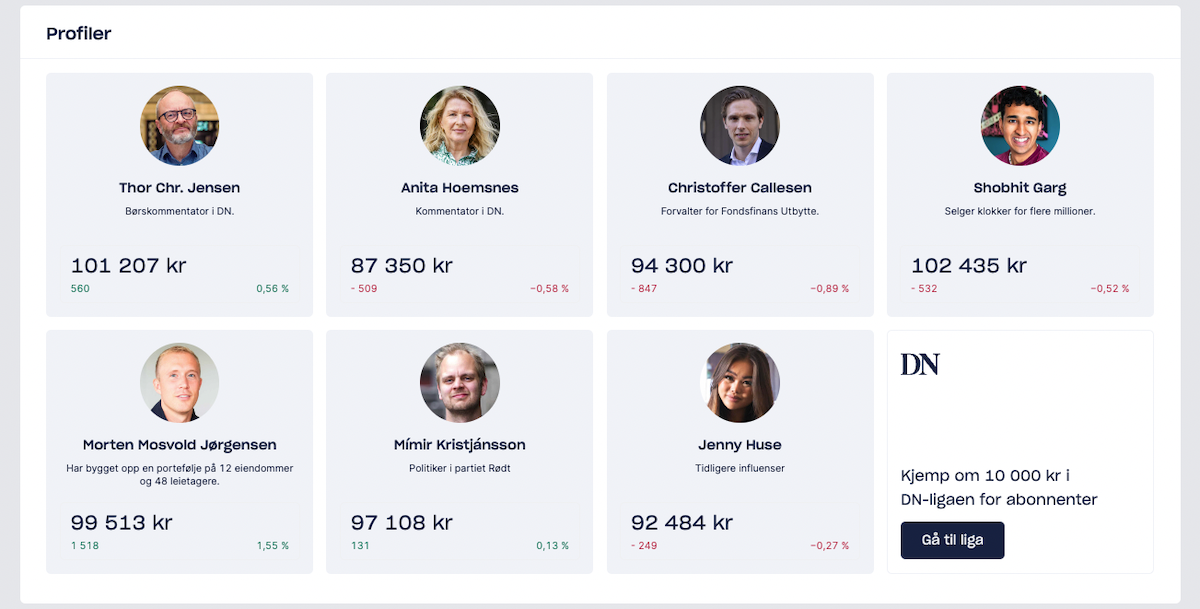
Dagens Næringsliv’s Fantasy Funds competition in 2023 allowed players to compete against high-profiles, ranging from influencers to financial experts, and follow their portfolio in the game.
6. Social competition, a core engagement mechanism
One of the strongest engagement drivers in publisher games is social comparison.
This applies across formats, from investment games to puzzles and time-limited challenges.
In Fantasy Funds games, user-created leagues allow players to compete with colleagues, peers, friends, or family members. This transforms the experience from a solo activity into a shared one, reinforcing motivation through community and friendly competition.
Leagues encourage discussion, repeat visits, and organic promotion as players invite others to join. The most successful media games are the ones poeple talk about, not just played.
7. Reward design determines retention
Big prizes attract attention, but they don’t sustain engagement on their own.
Successful media games balance aspirational prizes with frequent, smaller rewards. Weekly incentives, league-based prizes, and short-term challenges give players ongoing motivation, even if they are not competing for the top prize.
For investment games running over several weeks, a reward cadence is just as important as the reward value.

Børsen’s investment competition rewards winners with attractive rewards and weekly prizes.
8. Game length directly impacts engagement
Longer games are not necessarily better games, but they can service different strategic objectives.
From an engagement perspective, many publishers opt for an investment game length of around eight to ten weeks as this time span supports momentum, allows for consistent activation, and aligns well with editorial planning cycles.
At the same time, longer-running games can offer commercial advantages. For sponsors such as banks or financial institutions, a game that runs for twelve to sixteen weeks represents a more substantial marketing initiative than a short-term activation. Extended formats make it easier to justify sponsorship investment, particularly when the incremental cost of adding additional weeks is significantly lower than the fixed cost of launching the game.
So essentially, the game length should support publishers’ primary goal – whether that is maximising engagement momentum, supporting commercial partnerships, or balancing both within a single format.
9. Post-game engagement and long-term value
Fantasy Funds games typically generate thousands of highly engaged users in a short period of time. Players return frequently, make active decisions, follow markets and leagues closely, and willingly share first-party data about their interests and investment experience.
Yet much of the game’s real value lies in what happens after it ends.
Many publishers default to sending general newsletters to these new users. While this maintains light engagement, the game momentum fades.
The most successful publishers treat the end of the game as a handover moment – a deliberate transition from gameplay to a meaningful next step within their ecosystem.
The goal isn’t a single conversion, but a pathway toward deeper, longer-term relationships that can shift between editorial, community-based, or commercial.
Ways to sustain post-game momentum include:
- Investor-focused newsletter sign-ups
- Transitioning players to a real portfolio experience
- Educational or editorial portfolios with ongoing market insights
- Webinars or live events with editors or experts
- Introductory subscription offers
- Ongoing community experiences
When post-game engagement is planned as intentionally as the game itself, publishers significantly increase audience lifetime.
The real outcome: Confidence, not just participation
Across successful publisher-led games, one outcome consistently matters more than any metric: confidence.
Players in Fantasy Funds investment games consistently report feeling more confident about real-world financial decisions afterward.
For publishers, this reinforces their role as trusted guides and educators. For partners and sponsors, it builds credibility and long-term brand affinity.
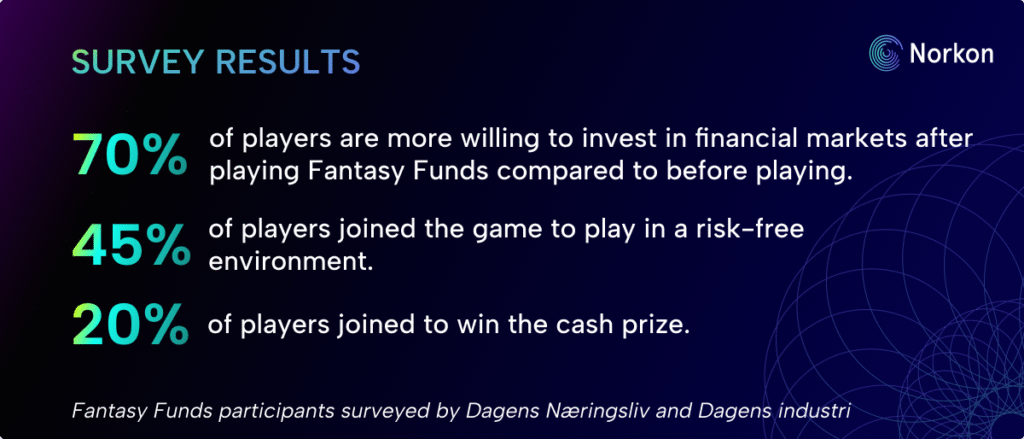
Fantasy Funds game survey results
Conclusion
To summarize, games don’t create engagement on their own.
Successful games for news publishers are not products to launch and forget, but long-term programs that require editorial thinking, strong partnerships, social mechanics, and continuous activation before, during, and after the game.
When executed well, games create moments of high attention, trust, and participation. When followed by a clear post-game strategy, they evolve into powerful engines for sustained audience growth, loyalty, and revenue.
For publishers willing to commit to the full lifecycle – from launch to post-game handover – games can become one of the most effective tools for building meaningful, long-lasting relationships with their audiences.
Read up on our case studies to discover how leading financial publishers went about it with their Fantasy Funds games.