SEO Lessons for Financial Publishers in an AI-First Search Era

 Norkon Team
 Financial publishers are operating in one of the most turbulent discovery environments in decades. Audiences no longer rely solely on established news brands to understand markets, investments, or economic trends. Instead, real-time financial updates compete with TikTok explainers, Reddit threads, newsletters, podcasts, and AI-generated summaries. And these often reaching audiences faster than traditional newsrooms can publish!
At the same time, expectations have changed – today’s private investors expect transparency, education, and interactivity, while often distrusting institutional voices shaped by legacy finance. Regulators are tightening rules around financial promotion and influencer content, while publishers are being asked to explain increasingly complex topics such as crypto, algorithmic trading, and AI-driven portfolios.
Against this backdrop, SEO is no longer just about rankings and clicks. It has become deeply tied to credibility, differentiation, and long-term audience trust.
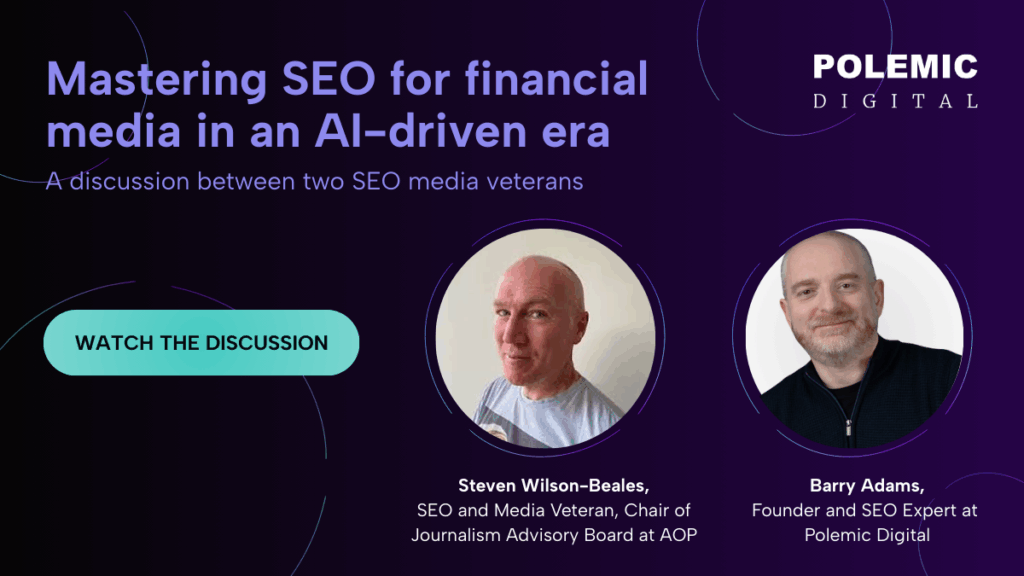
To shed some light on what’s still working and what not, we invited internationally renowned SEO strategist Barry Adams, Founder of Polemic Digital, and Steve Wilson-Beales, Chair of the AOP Journalism Advisory Board, for a Q&A on how financial media can protect search visibility, rebuild authority, and secure commercial outcomes in an AI-dominated era.
We summarised the core lessons from their discussion in this blog post.

Barry Adams, SEO expert at Polemic Digital (left) and Steve Wilson-Beales, former Head of SEO at Global and current Chair of the AOP Journalism Advisory Board (right) moderating the discussion
Q&A on SEO for financial media publishers
Steve W.-B.: What are the biggest shifts you’ve seen in how people discover financial information over the last few years?
Barry A.: Historically, people relied heavily on institutional financial outlets like the Financial Times, Wall Street Journal, or major investment portals. What we’ve seen over the last few years is a pronounced shift towards user-generated and social-first sources.
Platforms like Reddit have become hugely influential, while TikTok, YouTube, and other social channels now host entire ecosystems of investing advice. Crypto accelerated this shift because it was essentially “unclaimed ground,” allowing new voices to build authority quickly. Many of those creators have since expanded beyond crypto into broader financial commentary.
For newer or less financially literate audiences, these voices can be extremely seductive. They speak confidently, project authority, and are reinforced by engaged communities that like, share, and validate their opinions. As Barry puts it, “it’s not quite the Wild West – but not far off.”
That makes it harder for institutional publishers to compete for attention, especially among younger audiences. However, this shift shouldn’t cause panic. As people age and gain experience, their information habits tend to mature as well.
“We maybe shouldn’t be too alarmed that 18–25 year olds get their news from TikTok. As they move into their 30s, many will return to websites and search.”
The real challenge is ensuring your brand is present early in that awareness journey, even if social platforms are the first touchpoint.
With audiences consuming more content through mobile, voice search, and AI summaries, is it still worth investing in rich content formats?
Barry: Yes, but with realistic expectations. Not every user who consumes an AI summary was ever going to become a loyal reader or subscriber. Those users are looking for speed, not depth.
The real opportunity lies with audiences who want context, expertise, and insight, things AI summaries struggle to replicate well. While this may result in lower overall traffic, the traffic you do earn is often more valuable and more sustainable.
“Experts have not gone out of fashion.”
Publishers also need to accept that commoditised news is increasingly interchangeable. If your output is simply repeating what everyone else is publishing, AI tools will replace you.
To stand out, publishers need to lean into formats and approaches that are difficult to replicate at scale:
- Deep analysis and opinion
- Expert commentary
- Podcasts and video
- Unique editorial voices
Being memorable matters more than being ubiquitous. The biggest risk today isn’t traffic loss, but becoming forgettable.
What does SEO success actually mean for publishers today?
Barry: First, don’t panic, but do recalibrate expectations.
AI Overviews and direct answers are reducing click-through rates, often by around a third when they appear. However, Google remains the largest traffic source for most publishers. What has changed is that search is no longer a guaranteed growth channel.
“Search has flatlined. Maintaining traffic is now a win, and that’s a mindset shift publishers need to accept.”
In the past, SEO wasn’t truly zero-sum. Even ranking second or third could still deliver meaningful traffic. Today, if one publisher gets the click, another doesn’t. That makes SEO more competitive, and more important.
For SEO-mature publishers, success is about defence as much as growth: protecting existing visibility, optimising efficiently, and avoiding complacency. Relying on brand power alone is increasingly risky, especially as users trust Google’s rankings more than brand familiarity.
What are even the biggest publishers getting wrong with SEO?
Barry: Many large publishers rely too heavily on brand recognition and legacy authority. There’s often an assumption that people will click on their links because of the brand name.
That confidence isn’t always justified. Smaller or newer publishers can – and do – outrank established brands by being better optimised, technically cleaner, and scoring better on content relevance.
There are also structural issues, such as significant technical debt on large, complex sites; commercial decisions that conflict with SEO best practices; or cultural issue within some large newsrooms, where optimisation is seen as optional rather than essential. Long-established brands, in particular, can fall into the trap of assuming their reputation will do the work for them.
“There can be a sense of entitlement – that we should always get the click. That’s not how Google works.”
SEO still requires effort, alignment, and continuous improvement, regardless of brand size.
Should financial publishers be investing more in video?
Barry: Absolutely – without question. Publishers already sit on a goldmine of reusable content. A single investigative piece, for example, can be transformed into a podcast discussion, a long-form YouTube video and dozens of short clips for social platforms.
This approach aligns perfectly with how audiences now discover content: often through short, personality-driven video.
This highlights a growing shift towards journalists as public-facing experts. Not every reporter needs to be on camera, but those who are comfortable can help represent the publication beyond the written article.
“We love listening to people and watching people. That’s why podcasts and video are so popular.”
And importantly, it’s not too late. Video and podcasting are far from saturated if you bring genuine expertise and strong storytelling.
In financial media, how can publishers demonstrate real expertise and trust in a crowded AI and influencer landscape?
Barry: Trust is built through clarity, transparency, and human signals.
Publishers should clearly explain:
- Who they are and what they stand for
- How stories are sourced and verified
- Who their journalists are, with visible bylines and bios
- Editorial standards and correction policies
Linking out, even to competitors, can strengthen perceived authority, especially when journalists write for multiple reputable outlets.
These subjective trust signals translate into measurable outcomes: longer dwell time, repeat visits, brand searches, and deeper engagement, which are all signals that search engines can observe indirectly.
Should publishers invest heavily in structured data and live financial widgets?
Barry argues for focus and restraint, warning against over-investing in features that don’t meaningfully differentiate publishers.
Live rates, stock tickers, and comparison tables are largely commoditised. They’re expected, but on their own they rarely differentiate a publisher or build lasting loyalty.
That being said, it’s important to distinguish here between SEO-driven implementations and reader-value-driven ones. While standalone stock tickers built primarily to attract search traffic may no longer deliver meaningful SEO returns in an AI-first search environment, market data tools still play a critical role in increasing on-site engagement, loyalty, and subscription value. For financial publishers, interactive and contextual market data experiences are less about search visibility and more about what keeps readers coming back once they arrive.
The priority should therefore always be editorial value first, with technical enhancements supporting the wider publisher strategy.
For subscription-driven publishers, how should SEO support retention and trust?
Barry: SEO and paywalls are not mutually exclusive.
Google doesn’t penalise paywalled content, but user experience matters. Hard paywalls can cause high bounce rates, while metered or dynamic paywalls allow audiences to sample value before committing.
Barry is an advocate of paywalls, a view he admits to have changed over time.
“If you have something unique that people actively seek out, it’s perfectly reasonable to ask them to pay for it.”
Advertising alone is no longer a sustainable model for most publishers. Subscriptions, when paired with distinct value, are essential.
Finally, if you were advising a publisher CEO today, what two SEO-related investments would you prioritise for 2026?
Barry: Firstly, simplify the technology stack. Not every publisher needs to be a technology company. Custom CMSs and bespoke platforms often drain resources that would be better spent on journalism.
Partnering with specialised providers allows publishers to focus on their core mission.
Secondly, integrate AI into workflows in practical ways. AI can:
- Generate SEO-friendly headlines and intros
- Assist with internal linking
- Reduce repetitive optimisation work
Used properly, AI supports journalists rather than replacing them, by freeing up time for higher-value editorial work.
We hope you found this overview useful -> listen to the full conversation here!