
What Fantasy Funds Reveals About Audience Engagement and Investor Preferences
 Norkon Team
 Interactive formats continue to play a key role in how news publishers attract, engage, and retain audiences. As media organizations seek new ways to deepen reader relationships and deliver unique user experiences, formats like Fantasy Funds are proving to be more than just a nice-to-have game: they create participation, build habits, and most importantly, help audiences better understand financial markets.
To help publishers set realistic expectations and get a clearer sense of typical participation levels and player behaviour, we’ve put together the Fantasy Funds Benchmark Report 2025/26. Based on aggregated data from six games across different markets, the report shows how these engagement experiences actually perform in practice.
We summarize the key findings below. For deeper insights, download the full report.
About the benchmark report
The report draws on six Fantasy Funds games run in late 2025 across Canada, Finland, Estonia, the Netherlands, Belgium, and Switzerland.
The goal isn’t to present theory, but to give publishers something practical to work with. These benchmarks can help shape planning, set expectations, and improve future launches of their own stock market game initiatives.
Analysis
The report focuses on four key questions:
- How actively do players manage their portfolios during a game?
- How does engagement change over time, across different markets?
- Are there noticeable differences between markets?
- What should publishers realistically expect when launching a game?
1. Fantasy Funds’ consistent strong start and sustained engagement
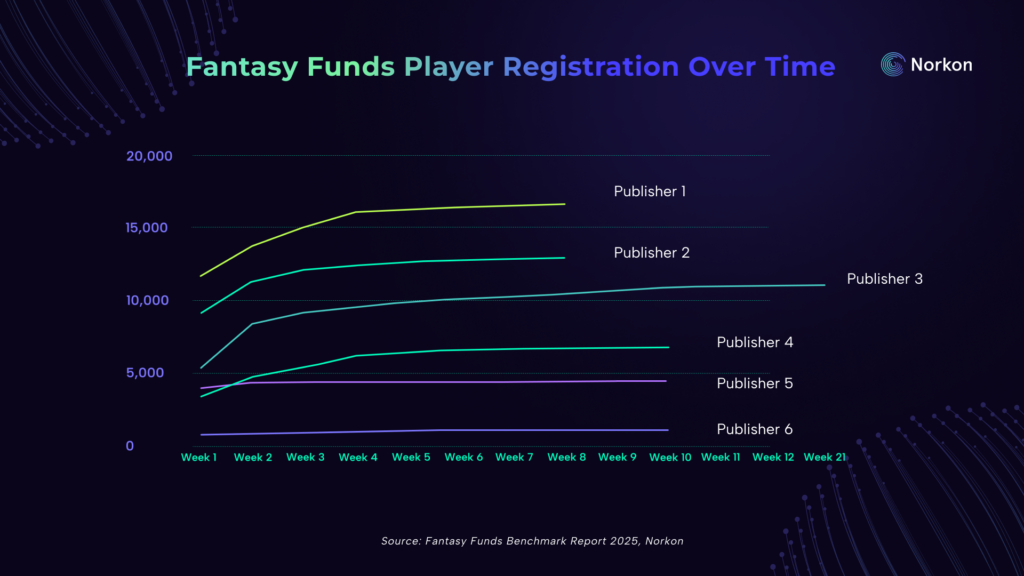
One of the clearest emerging patterns is that Fantasy Funds consistently attracts significant player volumes and maintains engagement over several weeks.
Registrations typically spike in the first one to three weeks after launch, before stabilizing and continuing at a steady pace throughout the game.
Takeaways:
- The soft-launch phase – the period where registration opens prior to the official competition start date – plays a bigger role than many expect. Opening registrations a few weeks in advance gives users time to explore the platform, create leagues, and invite other players.
- Across multiple implementations, between 25% and 55% of total registrations occur during the pre-launch period.
- Registrations plateauing after week three is a common trend and highlights the importance of sustained promotion, not only during the launch, but throughout the game period.
2. Conversion rates vary by publisher type
Another finding that stands out is how much conversion rates vary depending on the type of publisher.
- General news publishers typically see a 2.5%–3% conversion of website visitors to registered players
- Business and financial publishers, on the other hand, experience a 27%–28% conversion
These numbers highlight the importance of audience fit and relevance.
It shows that when the audience already has an interest in markets and investing, a format like Fantasy Funds becomes immediately relevant. The barrier to entry is lower, and the motivation to participate is higher.
3. Portfolio adjustments: A reliable measure of engagement
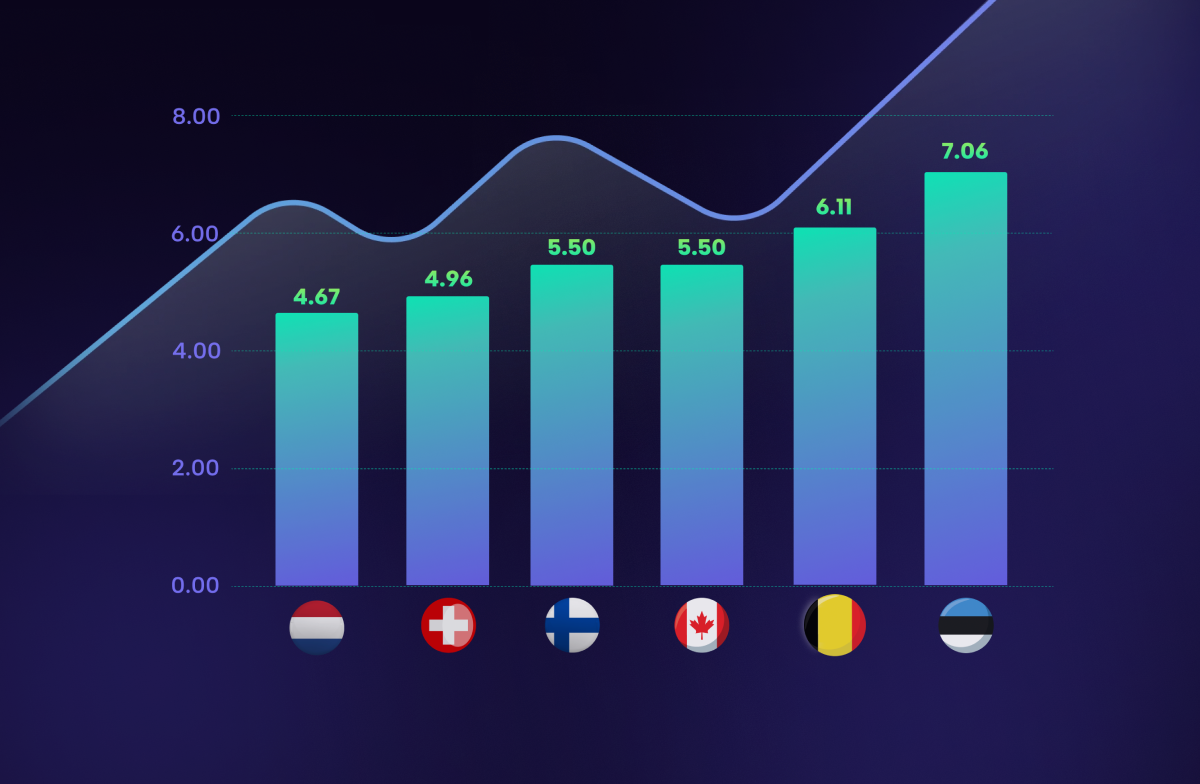
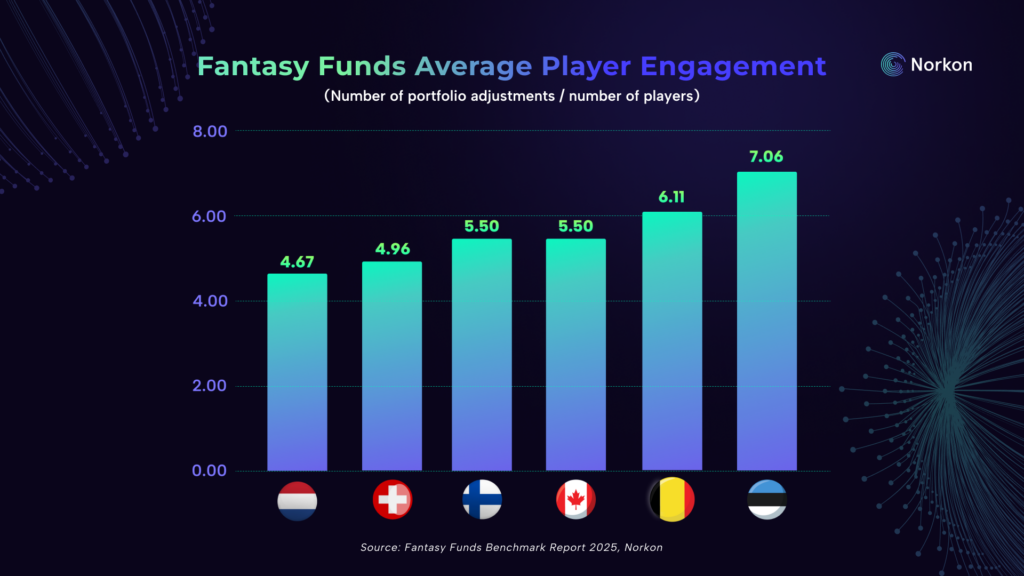
The report identifies portfolio adjustments – instances where players actively buy or sell stocks – as a reliable proxy for meaningful participation. This metric reflects deliberate decision-making rather than passive consumption.
Takeaway:
- Activity occurs throughout the game and peaks during decisive moments near the end of the competition
- Users aren’t just visiting, they are making decisions, returning regularly, and interacting with the experience over time
For publishers, this demonstrates how interactive investing experiences can drive repeat visits and sustained user interaction.
4. Social mechanics: A critical growth amplifier
One of the most consistent drivers of engagement is also one of the simplest: competition.
Users are able to create competitive groups, called leagues, to invite their friends, colleagues or family members to play along. Leagues can also be created by institutions to group members of a university or a company (or a game sponsor), serving different purposes while maintaining a core role in building a community and audience engagement.
Takeaway:
- Between 35 and 59 leagues are created per 1,000 players, highlighting the importance of social competition.
- League mechanism encourages peer-to-peer invitations, supporting organic growth, and strengthens a competitive motivation to play and return
At that point, growth is no longer just driven by the publisher, it’s driven by the players themselves.
5. The role of editorial teams: break it or make it
Another clear pattern is that media games supported by editorial teams perform significantly better.
Newsletters, homepage banner placements, and regular email updates all play a role, not just in driving registrations, but in keeping audiences engaged.
The most successful publishers treat their Fantasy Funds investment game like an editorial product, not a campaign.
Successful campaigns include:
- Pre-launch communication
- A visible launch moment
- Ongoing updates
- Final reminders toward the end
This highlights the importance of integrating Fantasy Funds into broader editorial and marketing workflows.
6. Player behavior reflects market trends
One of the more interesting observations is which stocks players invest in, which reflects broader market trends.
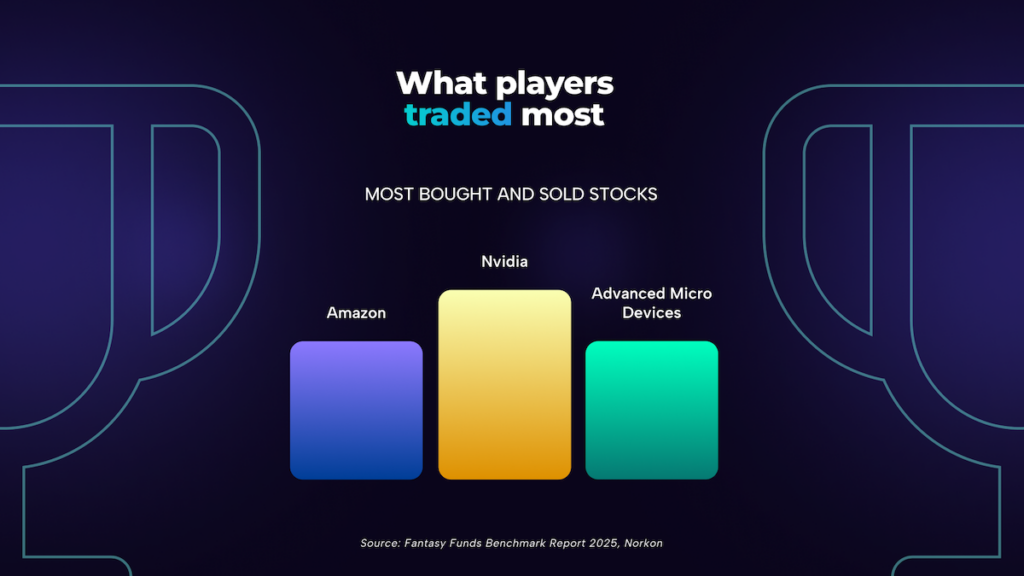
Fantasy Funds players in late 2025 showed a strong preference for technology and semiconductor stocks. Across all six games, companies such as Nvidia, Apple, Alphabet, Amazon, and AMD consistently ranked among the most traded assets in the game.
This aligns with broader retail investor behavior and provides publishers with opportunities to align editorial coverage with audience interests.
What this means in practice
The findings from the benchmark report confirm that publishers can drive strong engagement through formats like Fantasy Funds, but the implications go beyond a single product or format.
They point to a broader shift in how audiences interact with financial content.
First, retail investors are no longer passive readers. They increasingly want to participate, test ideas, and learn by doing. Interactive formats meet this expectation in a way traditional content alone cannot.
Second, engagement is becoming more behavior-driven. It’s not just about attracting readers, but about creating reasons for them to return. Experiences that involve decision-making, competition, or progression naturally lead to stronger habits.
Finally, player behavior closely mirrors real market trends. The concentration around major tech stocks and global narratives shows that audiences are already highly tuned into what’s happening in the market. For publishers, this creates an opportunity to align editorial coverage with what readers actively care about.
Taken together, these point toward a shift from content consumption to content participation, where the most effective publishers are those who create experiences, not just articles.
Download the full Fantasy Funds benchmark report
Want deeper insights and actionable benchmarks for your next game?
Download the Fantasy Funds Benchmark Report 2025/26 to explore detailed data, strategic recommendations, and industry trends.
Talk to our team about launching your next Fantasy Funds game!