Putting AI to the Test: Can We Trust Financial Information?

 Tonje Sørbye
I recently saw a post on LinkedIn where a parent shared a conversation with their kid. The parent showed the child an image, and the kid immediately responded: “That’s AI.”
Not long ago, we would have just said, “That’s fake.” Somehow, “AI” has become short for “not real.”
Being skeptical of what you read online is just common sense today. Social media feeds are packed with unverified noise, and when you ask a public AI tool a question, it can be difficult to know whether the answer is accurate or completely made up. Finding trusted financial information can be especially challenging.
When real money is at stake
If you are an everyday retail investor, that skepticism is critical. Regulators like the SEC have repeatedly warned people against trusting AI-generated financial advice. Making trades based on wrong earnings numbers, hallucinated metrics or conclusions can lead to real, painful losses.
Putting AI to the test
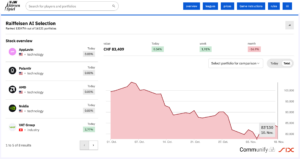
Swiss bank Raiffeisen is actually testing this in practice right now with a portfolio based on AI recommendations in the risk-free Finanz und Wirtschaft stock market game.
The experiment explicitly asks Copilot to take risks and maximize performance over an eight-week game. But a poorly performing portfolio doesn’t necessarily mean the information used was inaccurate.
At the time of writing, this portfolio is having a rough time: ranked 13,342 out of roughly 16,000 players, down almost 17%.
Unfortunately for the experiment, the timing was in the middle of a massive market turmoil. Some AI models are good at finding patterns in historical data, but they struggle with messy, unpredictable events.
Take the recent headlines surrounding Nvidia’s CEO as an example, with the board investigating whether he was targeted by a foreign intelligence effort. Predicting curveballs like that is no simple task, for humans or AI.
What is important to know is that an AI tool drawing on unverified web sources can blow viral rumors out of proportion or miss the real story completely. It takes professional journalists verifying facts, talking to sources, and cutting through market panic to provide the trusted financial information investors need before making a move.
Trust and expertise: Publishers’ biggest assets
This is why traditional financial media has such a massive opportunity right now.
For years, publishers worried about their content being scraped and given away for free.
But in an AI era flooded with synthetic noise, their biggest asset isn’t just content; it’s trust. Every media executive I speak with takes this responsibility very seriously.
Personalized updates, without the DIY
At the same time, some tech-savvy investors are “vibe coding” their own custom dashboards to track their portfolios. Building your own setup sounds empowering, but it has a huge catch: an app is only as good as the data fed into it. Cleaning live market data and keeping it accurate takes serious work. Most retail investors don’t want to become data engineers; they just want personalized and trusted financial information showing how market events affect their specific investments.
Publishers can bridge that gap. Instead of leaving readers to stitch together DIY tools with unverified data, media houses can offer smart, personalized views and alerts right on their own sites, backed by verified journalism.
At the end of the day, very few people want to build their own news engine from scratch. Most of us just want to access trusted financial information.