Scaling Personalization in Financial News: The Technology Behind Market Intelligence

 Norkon Team
 This is Part 2 of the Market Intelligence blog series I Part 1: Not every reader needs the same market story
How Market Intelligence Infrastructure Powers Financial News Personalization
Most AI tools publishers are currently building focus on LLM chat interfaces, article summarization, recommendation models, or newsroom productivity tools.
While these innovations deliver value at the content level, financial news personalization operates differently. The true unit of relevance is not the article itself, but the market event behind it.
A story matters not because it resembles something a reader previously read, but because it affects a company they follow, a sector they track, or a market they are exposed to.
In our previous post, we explored how financial readers increasingly expect market-relevant insights tailored to their personal interests. Delivering this experience requires connecting three layers: structured financial data, editorial content, and reader interests.
For many financial publishers, the question is not whether to build AI capabilities internally, but how to combine internal innovation with specialized intelligence layers that accelerate development and reduce complexity.
This is the architectural space where Norkon’s Market Intelligence is designed to operate.
Key takeaway of this blog post
Financial news personalization isn’t the same as content personalization, and can not rely only on behavioural recommendations.
To scale relevance for retail investors, a system must connect:
- Market events such as earnings, price movements, and macro signals
- Editorial coverage explaining those events
- Reader exposure through portfolios, watchlists, or followed sectors
When these layers are linked through structured market intelligence, personalization can move beyond recommending articles to delivering market-relevant insights tailored to each reader.
Why Personalizing Financial News Is Different from Personalizing General News
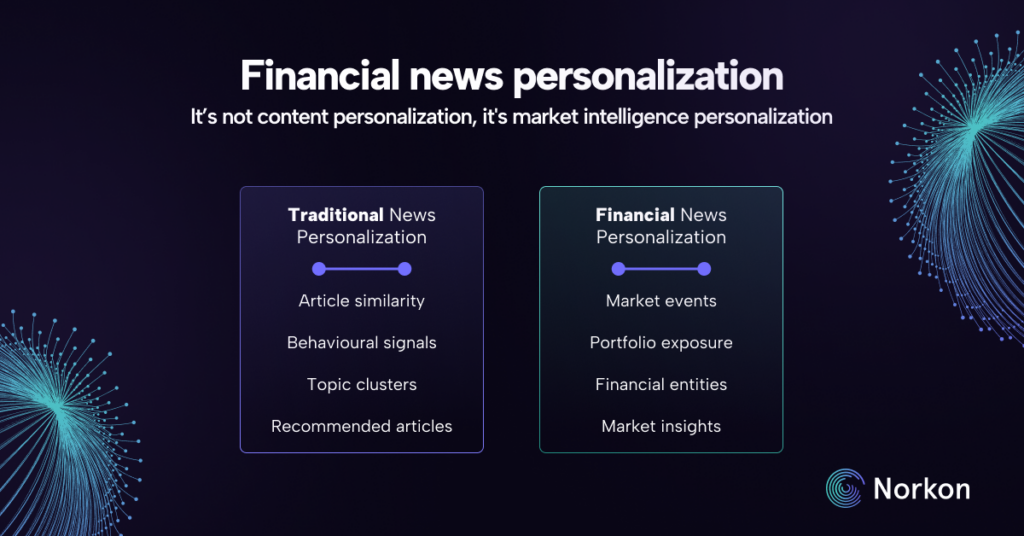
Most personalization systems in digital media rely primarily on behavioural signals such as article clicks, reading time and trending content patterns.
These approaches work well for general news, where reader interests tend to revolve around topics or themes.
Financial news follows a different logic.
Relevance is often determined by market exposure rather than content similarity. A retail investor following Nvidia may care about earnings announcements, supply-chain developments, semiconductor sector trends, or macro signals affecting technology stocks.
Scaling personalization therefore requires a system that understands financial market structures, not just article metadata. This is where a structured financial intelligence layer becomes essential.
Powered by Norkon’s technology, Market Intelligence leverages a robust backend that delivers metrics, calculations, correlations, technical indicators, and other advanced data points across the product. This intelligence layer enables publishers to uncover relationships between financial instruments in real time.
For example, correlation analysis can identify related companies, sectors, or indices, allowing editorial content about one instrument to be seamlessly connected to others. An article about Nvidia, for instance, can automatically surface alongside coverage of semiconductor ETFs, key suppliers, or broader technology indices.
By bridging structured market data with journalism, publishers can transform isolated stories into interconnected financial narratives and enhance discoverability, relevance, and reader engagement at scale.
Turning Market Data Into Personalization Signals
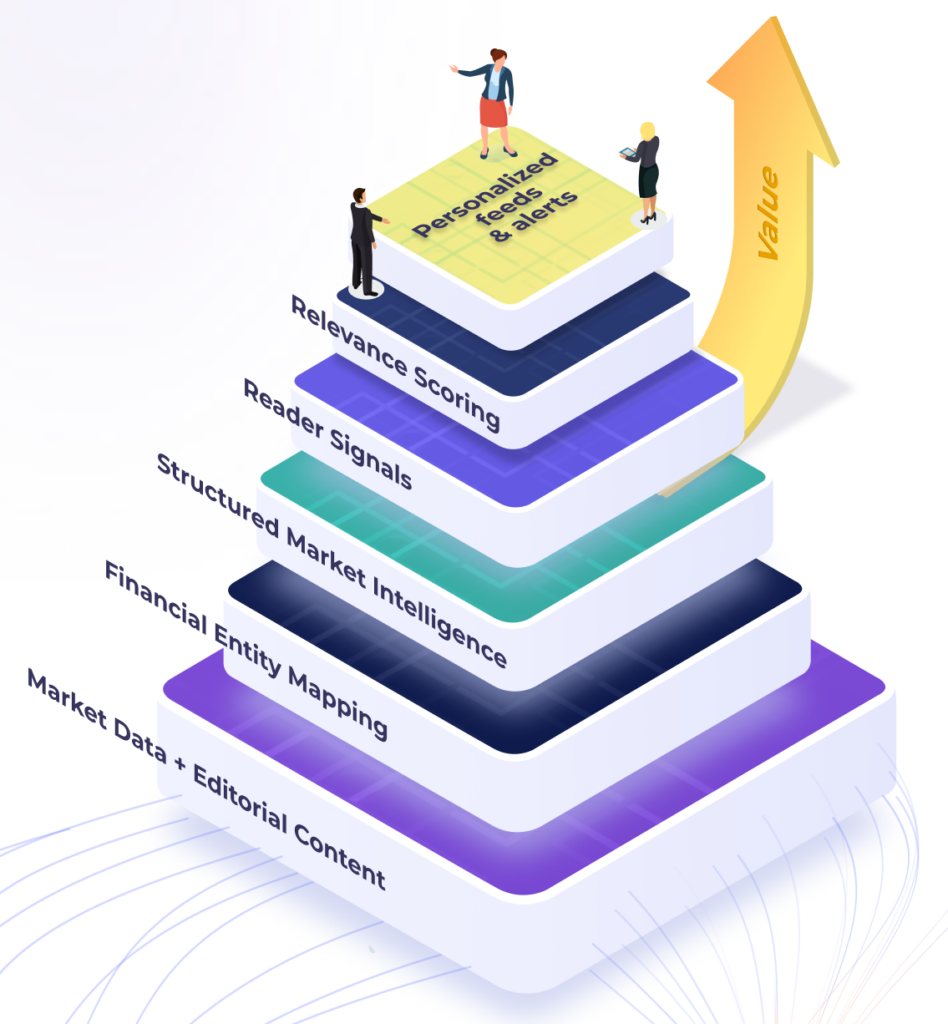
At the core of Market Intelligence is a pipeline that connects market data, editorial content, and reader signals into a unified intelligence layer.
- Market data: Real-time financial information such as price movements, earnings releases, company announcements, and macroeconomic indicators.
- Editorial content: Articles are analyzed and linked to financial entities such as companies, sectors, indices, and geographic markets. This creates a structured knowledge graph connecting stories to market developments.
- Reader signals: Market Intelligence then incorporates reader signals such as followed instruments, watchlists, portfolio trackers, and reading behaviour.
Together, these layers enable Market Intelligence to generate relevance signals tied directly to market events, rather than relying solely on reading behaviour.
Building this type of system requires more than entity tagging or article recommendations. Financial markets generate thousands of signals every day, from earnings announcements and regulatory filings to price movements and macroeconomic events.
To make these signals usable for personalization, they must be continuously structured, linked to editorial coverage, and mapped to reader interests in real time. This involves maintaining a dynamic financial knowledge graph where companies, sectors, indices, and market events are constantly connected.
At scale, this becomes less a recommendation challenge and more an infrastructure challenge, requiring systems that can interpret market events, link them to journalism, and translate them into relevance signals for millions of readers simultaneously.
This is the intelligence layer that enables financial personalization to scale.
The Personalization Pipeline
Scaling financial news personalization requires infrastructure that continuously processes multiple data streams. Instead of simply recommending similar articles, the system identifies which market developments matter most to each reader at any given moment.
From Personalization Signals to Liquid Content
Once structured market intelligence and reader signals are connected, personalization can move beyond static article recommendations.This is where the concept of liquid content emerges.
Liquid content refers to financial information experiences that continuously adapt to market events, new editorial coverage, and reader interests.
Instead of publishing static content that is identical for every reader, liquid content allows information to flow dynamically across the product.
Examples include personalized market briefings, portfolio-driven alerts, dynamic sector summaries, and continuously updating market blogs.
Because the underlying intelligence layer understands both market events and reader exposure, content can automatically adapt to the context of each user.
Automating High-Frequency Market Coverage
Financial newsrooms produce large volumes of market-driven content such as market open and close summaries, earnings coverage, sector updates, and live market blogs.
These formats are highly valuable for readers but often resource-intensive for editorial teams, especially when updates must follow markets in real time.
By connecting structured market data with editorial context, systems like Market Intelligence power dynamic market coverage formats where updates are generated automatically as events occur.
For example, a live market blog can continuously incorporate price movements, corporate announcements, sector developments, and relevant editorial coverage.
This allows journalists to focus on analysis and in-depth reporting, while high-frequency market updates are automatically generated and personalized for both end-users seeking relevant insights and for journalists covering the market.
Personalization at the Scale of Financial Markets
The scale of financial news makes personalization a persistent challenge.
With countless market developments and diverse reader interests to serve, traditional editorial workflows can only go so far.
However, by linking market signals, editorial coverage, and reader interests through a structured intelligence layer, personalization becomes both practical and scalable.
The same infrastructure that powers liquid content can generate:
- Personalized market summaries
- Portfolio-relevant alerts
- Tailored sector insights
- Dynamic financial dashboards
Each reader effectively receives a different version of the financial news environment, shaped by the instruments and markets they care about.
Conclusion
As financial publishing evolves, personalization is moving beyond article recommendations toward a more dynamic model where market intelligence, journalism, and reader interests are continuously connected.
When this infrastructure is in place, financial news can evolve from static article feeds into adaptive information experiences – where the most relevant insights surface automatically as markets move.
Market Intelligence is designed to power this intelligence layer, helping financial publishers turn market data, editorial coverage, and reader signals into scalable, personalized experiences.
→ Curious to learn more? Explore Market Intelligence
-> Read part 1 of this blog series: Not every reader needs the same market story